Deep Dive Article
The Rise of GCCs in India: Why Global Companies Are Hiring Directly While Traditional IT Struggles
A Silent Revolution Is Happening in India's Tech Industry

But beneath the surface, another transformation is taking place.
Global multinational companies are increasingly choosing to establish Global Capability Centers (GCCs) in India instead of outsourcing work to traditional IT vendors.
The numbers tell the story.
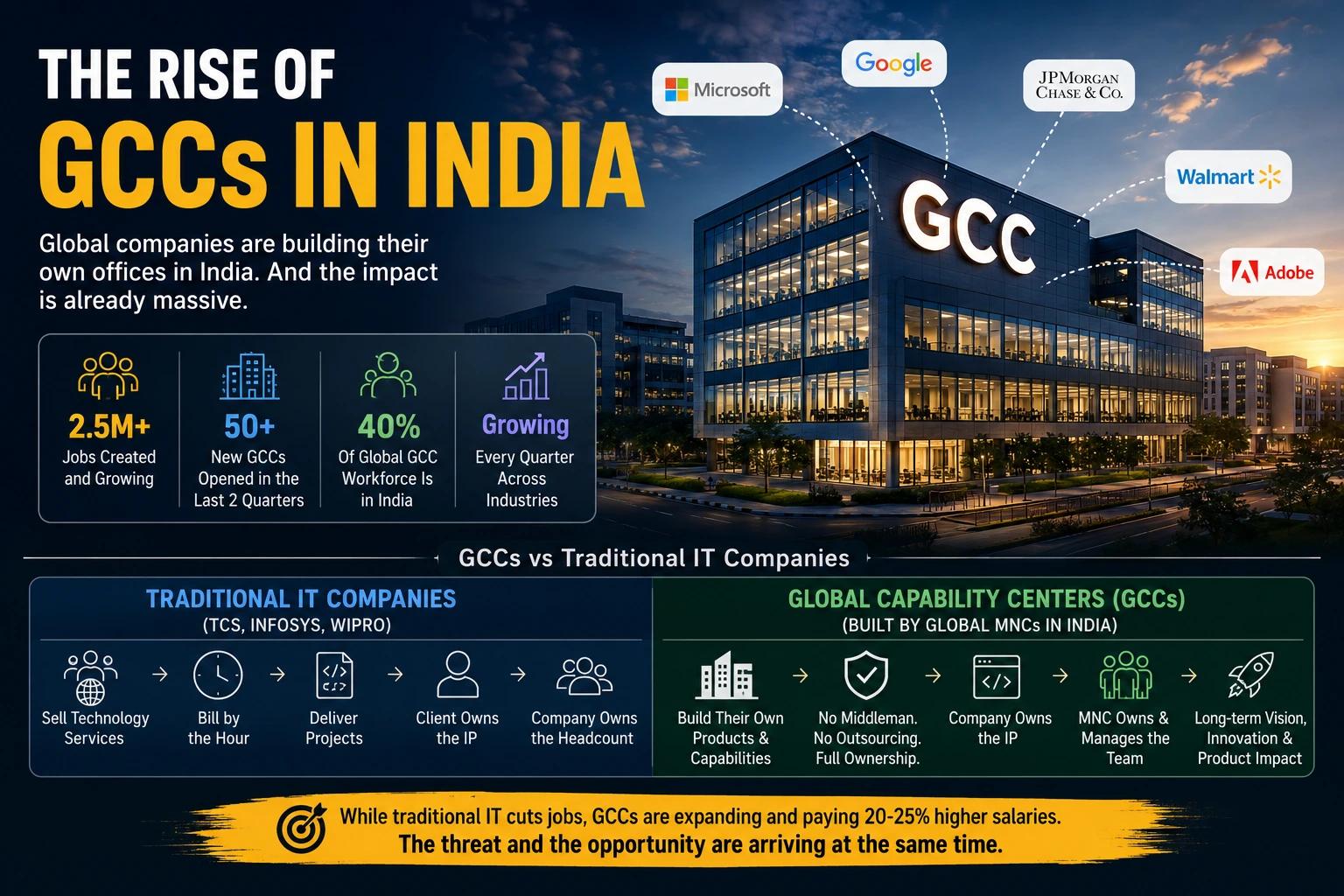
India's GCC ecosystem has already created over 2.5 million jobs, and new centers continue to open every quarter. While many IT service companies are slowing hiring or optimizing headcount due to AI, GCCs are expanding aggressively.
This isn't just another hiring trend.
It represents a structural shift in how global companies build technology.
What Exactly Is a GCC?
A Global Capability Center (GCC) is an offshore office owned and operated directly by a multinational company.
Unlike outsourcing vendors, a GCC isn't a third-party service provider.
Instead, it functions as an extension of the company's global engineering, product, finance, operations, cybersecurity, AI, cloud, and research teams.
Think of companies like:
- Microsoft
- JPMorgan Chase
- Walmart
- Goldman Sachs
- Adobe
- Target
- Cisco
Many of these organizations already run massive engineering organizations from India - not through vendors, but through their own internal teams.
GCC vs Traditional IT Services
Although both employ software professionals, their business models are fundamentally different.
Traditional IT Services
Companies such as TCS, Infosys, and Wipro primarily:
- Build software for external clients
- Charge based on projects or billable hours
- Deliver technology services
- Operate under client-defined requirements
- The client owns the intellectual property
Success depends heavily on utilization, project pipelines, and client spending.
Global Capability Centers
A GCC works differently.
The multinational company itself hires engineers in India to build:
- Internal platforms
- Customer-facing products
- AI solutions
- Cloud infrastructure
- Data platforms
- Cybersecurity systems
- Research initiatives
- Business operations
There is no outsourcing layer.
No intermediary.
The company owns both the product and the engineering team.
Developers often contribute directly to products used by millions of customers worldwide.
Why Are GCCs Growing So Fast?
Several long-term factors have converged to make GCCs more attractive than ever.
1. Artificial Intelligence Changed the Economics
Historically, setting up an international engineering center required significant scale.
Companies often needed hundreds of employees before operational costs became worthwhile.
AI and automation have fundamentally changed that equation.
Developer productivity has increased through AI-assisted coding, automated testing, documentation generation, and workflow optimization.
Today, even teams of 50–60 highly productive engineers can justify establishing an internal capability center.
This makes GCCs financially viable for mid-sized global companies—not just Fortune 500 enterprises.
2. India Offers World-Class Engineering Talent
India has evolved far beyond being a low-cost outsourcing destination.
Today, it produces one of the world's largest pools of software engineers specializing in:
- Artificial Intelligence
- Cloud Computing
- Data Engineering
- Cybersecurity
- Platform Engineering
- DevOps
- Mobile Development
- Product Engineering
The quality gap between Indian and Western engineering teams has narrowed significantly.
For multinational companies, India now offers an exceptional combination of:
- High technical expertise
- Strong English communication
- Mature engineering ecosystems
- Cost efficiency
- Time-zone flexibility
3. Long-Term Cost Efficiency
Building internal teams in India remains considerably more economical than hiring equivalent talent in North America or Europe.
This isn't simply about reducing salaries.
Companies also gain:
- Better engineering scalability
- Faster hiring
- Lower operational costs
- Access to specialized talent
- Continuous innovation
These factors make India one of the most strategic global technology hubs.
Why Traditional IT Companies Face a Different Challenge
The IT services model depends heavily on billable projects.
When clients:
- Reduce technology spending,
- Delay projects,
- Automate work using AI,
service providers often experience pressure on utilization and hiring.
AI further changes the equation by automating repetitive development, testing, support, and documentation tasks.
As a result, many IT firms are becoming leaner.
Meanwhile, GCCs are investing in building long-term product capabilities rather than short-term project delivery.
Different business models create different hiring patterns.
What This Means for Software Engineers
For professionals, this shift presents both opportunities and challenges.
Increasingly valuable skills include:
- Product engineering
- Artificial Intelligence and Machine Learning
- Cloud-native development
- Distributed systems
- Data engineering
- Platform engineering
- DevOps and Site Reliability Engineering
- Cybersecurity
- System design
- Product thinking
- Business domain knowledge
Technical expertise alone is no longer enough.
Engineers who understand products, customers, and business outcomes will stand out.
Why GCCs Often Offer Better Career Growth
Many professionals choose GCCs because they frequently provide:
- Higher compensation
- Global product ownership
- Better engineering culture
- Modern technology stacks
- Direct collaboration with international teams
- Clear technical career progression
- Opportunities to influence product decisions
Instead of implementing requirements for clients, engineers often help define what gets built.
That difference can significantly enhance career development.
Is This the End of Traditional IT?
Not at all.
India's IT services industry remains one of the largest technology employers in the world and will continue to play a critical role in global digital transformation.
However, the industry is evolving.
Traditional IT companies are increasingly investing in:
- AI services
- Cloud consulting
- Platform modernization
- Digital engineering
- Managed services
At the same time, GCCs continue expanding across industries including finance, healthcare, retail, manufacturing, automotive, logistics, and technology.
Rather than replacing one another, both models will coexist—but with different value propositions.
Final Thoughts
The rise of Global Capability Centers is more than a hiring trend.
It reflects a fundamental shift in how multinational companies view India - not merely as an outsourcing destination, but as a strategic hub for innovation, engineering excellence, and product development.
For software professionals, this is an opportunity to rethink career paths and invest in skills that align with an AI-driven future.
As AI transforms the software industry, one thing is becoming increasingly clear:
The next generation of engineering careers may be built inside GCCs, not just traditional IT service companies.
The future isn't arriving quietly anymore - it's already taking shape across India.
What are your thoughts?
Do you see GCCs becoming the preferred destination for software engineers over traditional IT service companies in the coming years? Share your perspective in the comments.