Deep Dive Article
The Big Tech AI Acronym (MANGOS): Why AI Is Creating a New Technology Powerhouse
The Big Tech AI Acronym (MANGOS): Why AI Is Creating a New Technology Powerhouse

Today, however, the technology landscape is changing.
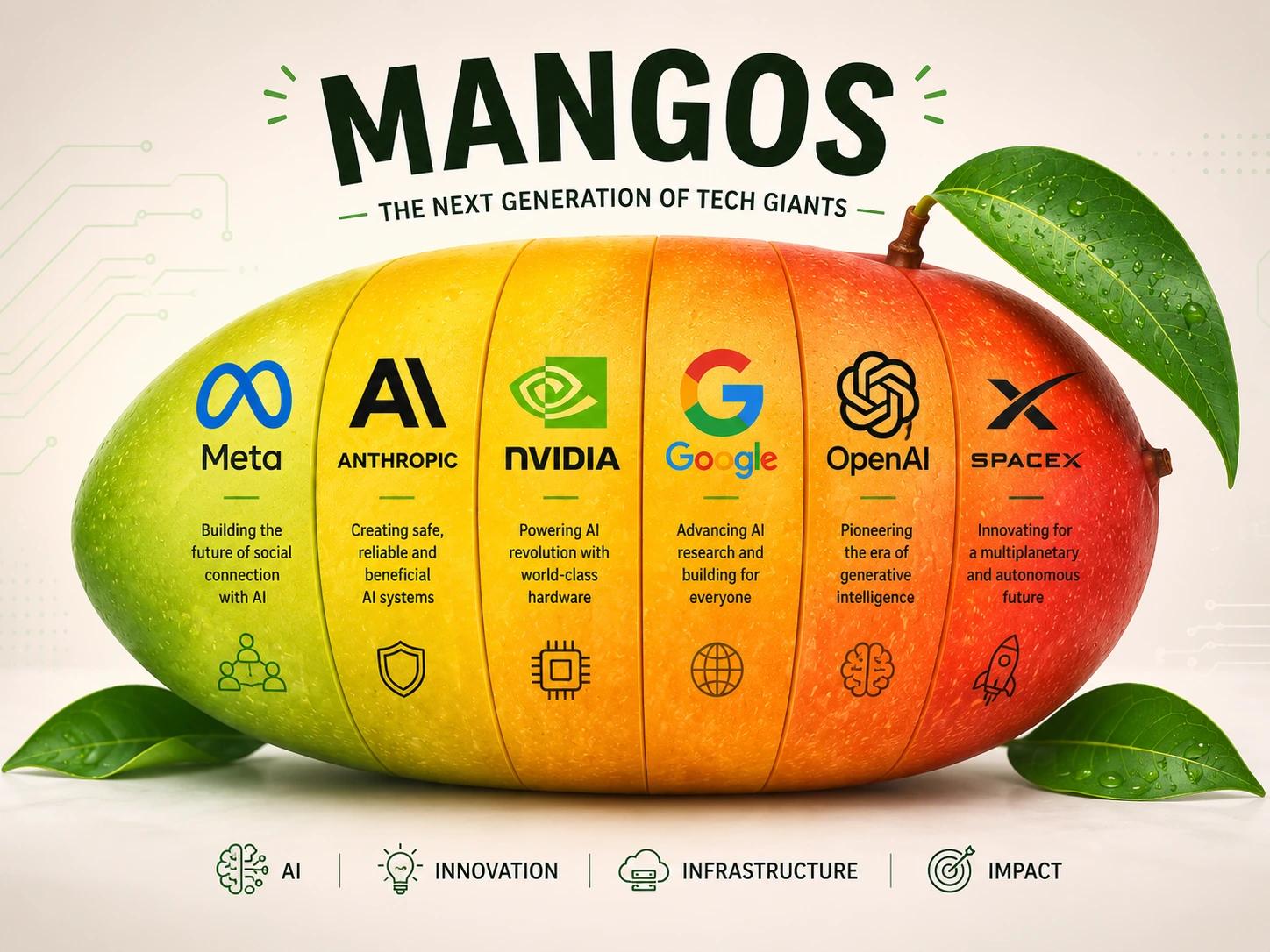
A new acronym is emerging in discussions around artificial intelligence and next-generation technology companies: MANGOS.
As AI becomes the driving force behind innovation, companies leading advancements in machine learning, large language models, AI infrastructure, and autonomous systems are becoming the new center of attention.
In this article, we'll explore what MANGOS means, why it matters, and what software engineers should learn from this shift.
What Is MANGOS?
MANGOS commonly represents:
- Meta
- Anthropic
- Nvidia
- OpenAI
- SpaceX
Unlike FAANG, which reflected dominance in social media, e-commerce, streaming, and internet services, MANGOS highlights companies building the future of artificial intelligence and advanced computing.
These organizations are investing billions of dollars into:
- Generative AI
- Large Language Models (LLMs)
- AI Infrastructure
- Data Centers
- Autonomous Systems
- Robotics
- Advanced Computing Platforms
The emergence of MANGOS reflects the industry's belief that AI will become the foundation of the next technology revolution.
Why FAANG Is No Longer Enough
FAANG defined an era where the internet became central to everyday life.
Those companies changed how people:
- Communicate
- Shop
- Consume content
- Search for information
- Use mobile devices
While these areas remain important, today's most exciting breakthroughs are occurring in artificial intelligence.
Organizations are now competing to build:
- More capable AI models
- Faster AI infrastructure
- Better reasoning systems
- AI-powered productivity tools
- Autonomous agents
This shift is why companies like Nvidia, OpenAI, and Anthropic are now being discussed alongside traditional technology giants.
Breaking Down the MANGOS Companies
Meta
Meta has become one of the largest AI investors globally.
Its Llama family of models has accelerated open-source AI development and enabled organizations worldwide to build custom AI solutions.
Meta's long-term vision includes AI assistants, intelligent social experiences, and AI-powered computing platforms.
Anthropic
Anthropic has quickly established itself as a major AI company through Claude AI.
The company focuses heavily on AI safety, alignment, and enterprise adoption, making it one of the strongest competitors in the large language model space.
Nvidia
No company has benefited more directly from the AI boom than Nvidia.
Its GPUs power the majority of AI model training and inference workloads across the industry.
Whether it's OpenAI, Google, Anthropic, or startups building AI products, Nvidia hardware remains a critical component of modern AI infrastructure.
Google has been investing in AI for decades.
Through DeepMind, Gemini, Tensor Processing Units (TPUs), and advanced research initiatives, Google remains one of the most influential AI organizations in the world.
OpenAI
OpenAI helped bring generative AI into the mainstream.
The launch of ChatGPT demonstrated the practical value of large language models and accelerated AI adoption across industries.
Today, OpenAI is shaping how businesses integrate artificial intelligence into products and workflows.
SpaceX
Although primarily known for space exploration, SpaceX contributes to future technology infrastructure through autonomous systems, satellite communications, and advanced engineering innovations.
Its inclusion in MANGOS reflects its role in enabling future intelligent systems at a global scale.
What MANGOS Means for Software Engineers
The rise of MANGOS signals an important change in software development.
Traditional software engineering skills remain valuable, but AI knowledge is becoming increasingly important.
Developers who understand both software engineering and artificial intelligence will likely have a significant advantage in the coming years.
Key areas worth learning include:
- AI Application Development
- Prompt Engineering
- AI Agents
- Retrieval-Augmented Generation (RAG)
- Vector Databases
- Machine Learning Fundamentals
- Distributed Systems
- Cloud Infrastructure
- System Design
How Full Stack Developers Can Prepare
As a Full Stack Developer, you don't need a PhD in machine learning to benefit from AI.
Many opportunities exist for developers already working with technologies such as:
- React
- Node.js
- JavaScript
- TypeScript
- PHP
- Laravel
- Angular
- Vue.js
The most practical next steps include:
1. Learn AI APIs
Start integrating AI capabilities using OpenAI and other model providers.
2. Build AI-Powered Features
Add chatbots, content generation, recommendation systems, and semantic search capabilities to existing applications.
3. Understand AI Architecture
Learn how vector databases, embeddings, retrieval systems, and AI agents work together.
4. Strengthen System Design Skills
AI applications introduce new scaling, security, and performance challenges that require strong architectural thinking.
The Future of MANGOS
Whether MANGOS becomes a universally accepted industry acronym remains uncertain.
What is certain is that artificial intelligence is becoming the most important technology trend of the decade.
The companies investing heavily in AI research, infrastructure, and deployment are likely to shape the future of:
- Software Development
- Healthcare
- Education
- Finance
- Transportation
- Scientific Research
For software engineers, this is an exciting opportunity to adapt, learn, and participate in one of the most significant technological shifts in history.
Final Thoughts
FAANG represented the internet era.
MANGOS represents the AI era.
As artificial intelligence continues to transform industries, engineers who combine strong software development fundamentals with AI expertise will be best positioned for future opportunities.
Whether you're a React developer, Node.js developer, software architect, or full stack engineer, now is the perfect time to begin exploring AI technologies and understanding the companies driving this transformation.
About the Author
Saurabh Sharma is a Senior Software Engineer and Full Stack Developer with expertise in React, Node.js, JavaScript, PHP Laravel, Angular, Vue.js, System Design, AI Integration, and scalable enterprise application development.